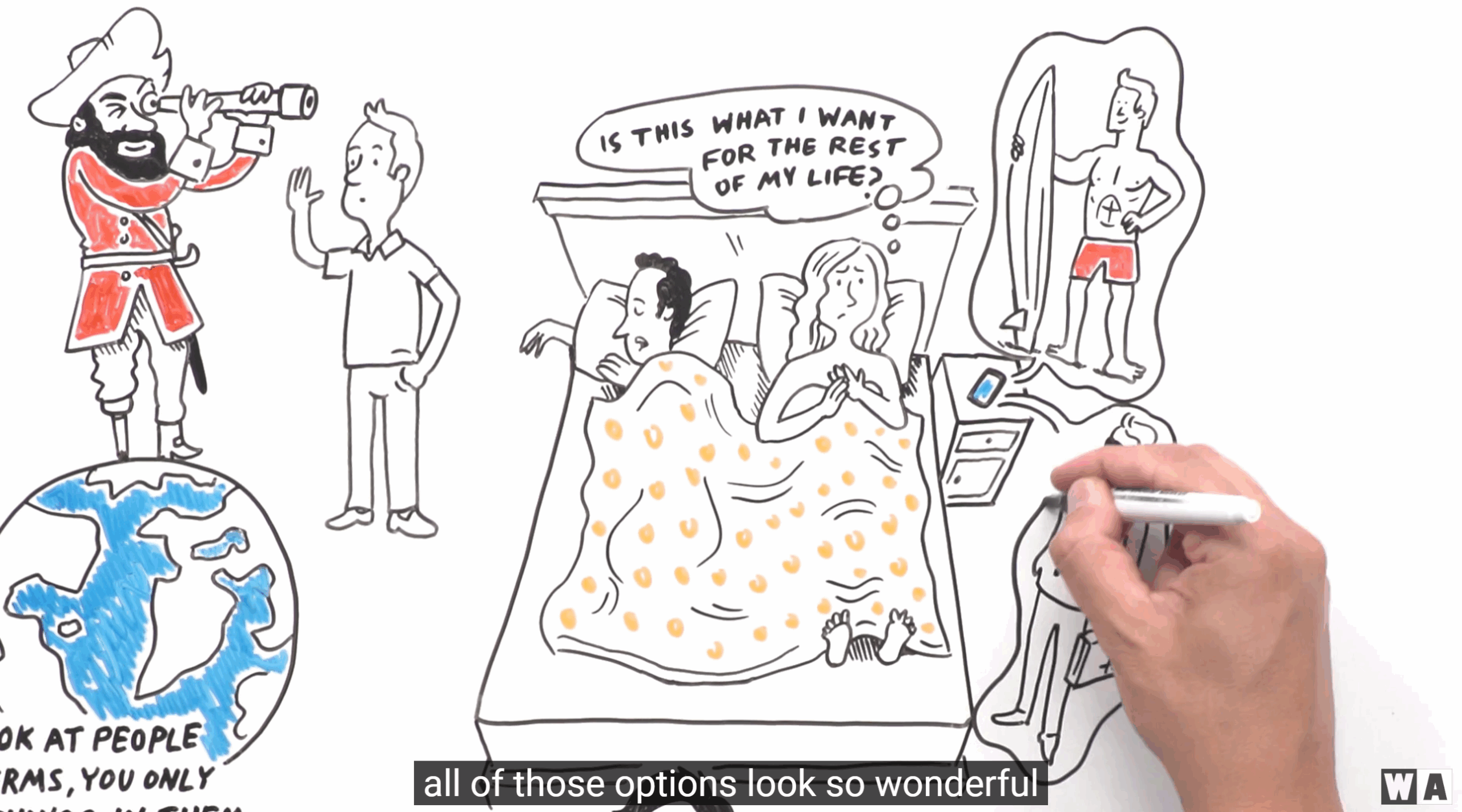


The relationship ended (or you are thinking of ending it). You have taken 30 days to refocus on yourself, and you still have your doubts (or you know it's done). What do you do? Your heart hurts. You still long for the person; your mind still focuses on who you imagined they and the relationship could have become.
And in that realization is your answer moving forward: your sadness is not necessarily about them it's about who you felt you were and who you wished they were and in that is your answer for your breakup or divorce sadness: how do you fall OUT of love?
A viral relationship trend makes a dramatic promise and may have your answer: six questions can provide you your answers and clear your direction in about 15 minutes.
Online posts call it the “Deromanticization Protocol.” The six questions are an internet-popularized reflection exercise.
The exercise is meant to pull you out of the fog of idealization and force a cleaner look at the relationship you have now, not the one you hope it will become. When people feel strongly attached, they often give extra weight to chemistry, old memories, rare, good moments, future promises, and the fear of being alone. That can make present-day reality harder to see.
This reality check shifts your attention to concrete behavior. What is this person actually doing now? How do they treat you consistently? What has the relationship required from you, and what has it given back? That matters because observable patterns usually tell the truth faster than romantic hope does.
The six questions also create psychological distance. Instead of asking, “How do I feel right this second?” they ask you to look from slightly outside the relationship, almost like a careful witness. That outside perspective can reduce the influence of fantasy, urgency, and attachment-driven excuses.
That is the real value here. The exercise is designed to support clearer judgment, not to magically erase emotion in 15 minutes.
If Questions Can Create Intimacy, Perhaps Questions Can Create Resolution and Healing
The idea of "what questions could help a person move on from a broken relationship?" found its inspiration in another social media topic popularly known as the The 36 Questions to Fall in Love. In that experiment, a psychologist experimented with questions that created connection.
The viral "6 Questions to Fall Out of Love" trend borrows the similar logic: if questions can create connection, couldn't the correct questions also help in separation?
The six-question reality check encourages behavioral evaluation and emotional distance.

Why a Reality Check Can Feel Powerful
Romantic idealization can cause us to focus on what a relationship could become rather than what it consistently is.
You may replay the best date, the sweetest message, or the first few months of intense chemistry. You may keep believing in the person’s potential while minimizing current unreliability, emotional distance, or repeated broken promises.
A reality check interrupts that pattern.
It asks you to compare:
- Promises with behavior
- Chemistry with compatibility
- Memories with current reality
- Sacrifice with reciprocity
- Attachment with genuine emotional safety
This does not mean idealization is always harmful. Research on positive illusions has associated favorable perceptions of a partner with relationship satisfaction, commitment, and persistence. Seeing the best in someone can help couples tolerate ordinary imperfections.
The goal is not cynical de-romanticization.
The goal is clearer judgment.
A healthy relationship does not require you to see your partner as flawless. It requires you to see the whole picture.
The Six-Question Relationship Reality Check
1. What exactly does this person do for me every day?
This question is not about what we think we feel about what the other person does for us, or what we think they do for the relationship, but rather to make a list of what actions he/she did for you every day. Focus on their observable, consistent actions through the relationship, not "that one thing they did a year ago."
Do they communicate reliably? Show consideration? Follow through? Make room for your needs? Repair problems after conflict?
Do not rely on an abstract feeling such as “They love me.” Do not use one wonderful gesture from a year ago as proof of a current pattern.
Write specific examples they consistently did.
The question is not designed to erase everything good. It is designed to reveal what actually happened. This is the time to realize that you don’t really love the person, but the memory.
2. If I met this person today for the first time, knowing everything I know now, would I choose them again?
Be honest. As yourself, knowing everything that you know now, would you choose them again? These are some of the questions you can ask yourself. This is not about what we think they do, but about what they actually do. Consider the complete relationship, not just the attraction.
How do they behave during conflict? Do they keep promises? How do they treat you on a bad day? Do they respect your boundaries? Can they take responsibility without turning every issue back on you?
This question can expose the difference between choosing a real person and staying loyal to who you hoped, wished, or dreamed they "could" be.
3. How many times have I changed myself, my plans, and my boundaries for them: and how many times have they done the same for me?
Compare effort in both directions.
Have you repeatedly canceled plans, abandoned priorities, tolerated behavior you said you would not accept, or reshaped your identity to keep the relationship stable?
What adjustments have they made for you?
Write two lists, one for the things you do for them and one for the things they do for you, and if they reciprocate what you do for them. If yours are 5 times longer, you don’t love the person. You are addicted to sacrificing.
A healthy relationship involves give and take, not permanent self-erasure.
4. What do I get from this relationship that I could not get from other relationships or from myself?
This question is not about love or support; it should be something unique. Love and support, even most of the things that we value in a partner can be found in friends, mentors, family, or self-development.
If the relationship is your only source of comfort, validation, or belonging, loneliness can make attachment feel like compatibility.
And if you feel lonely without the company of your significant other, then maybe it’s time to develop your relationships outside of just the two of you – working to fulfill your own needs; building community, interests and hobbies; developing relationships with friends, family connections.
The question is, "What love or support did this person actually give you that you could not get elsewhere?"
5. Who have I become next to this person: better, worse, or simply different?
Look at yourself and reflect. Who exactly were you before you met this person, compared to now? Did you become better? Did you grow? Did you become stronger? Did you become calmer and more confident? Or did you become more anxious, closed off, and less alive?
Are you more confident, calm, expressive, energetic, and secure?
Or are you more anxious, isolated, guarded, exhausted, or disconnected from the person you used to be?
Every relationship changes us. Some for the worse. Repeated fear, anxiety, shrinking, self-doubt, and isolation deserve attention.
Your relationship should make room for your evolution and growth: not require you to become smaller.
6. If my best friend were in this relationship, what would I tell them?
Imagine that your closest friend describes their relationship exactly as yours is. Would you tell them to stay?
What would you notice? What would concern you? What would you encourage them to protect?
Looking at your relationship from the outside makes things clearer. This question helps you apply the same wisdom to yourself that you might offer someone you love. Be honest about the situation, always.
Use the question to identify what your own fear, hope, or attachment may be preventing you from admitting.

How to Use the Questions Responsibly
If you try this exercise, make it more useful than a fast social-media trend:
- Write your answers down, as specific as possible. Separate actual events from general impressions.
- Separate facts from interpretations. “They canceled three times” is a fact. “They do not care about me” is an interpretation.
- Look for patterns over time. One bad day does not define a relationship. Repeated behavior matters.
- Answer all six questions. Do not use only the question that confirms what you already want to believe.
- Reread your answers after 24 hours. Emotional intensity can distort judgment in either direction.
- Take action based on logic, rather than emotion. This time, don't base your decisions off of hopes or fear. Let your mind make the decisions that are best for you..
Keep it practical: answer honestly, respect your own boundaries, and if the relationship involves fear, coercion, abuse, or serious confusion you cannot sort through alone, pause the exercise and get support from a trusted person, therapist, or local professional resource.
Do not make a major decision solely because a viral post promises that your feelings will disappear.
The 36 Questions Versus the Six-Question Reality Check
These six questions cannot erase love on command. But they can help you think more clearly when used with honesty, patience, and judgment.
The most mature question is not, “How can I turn my feelings off in 15 minutes?”
It is, “What is this relationship giving me: and am I willing to see it?”
Sources and Research Note
- Aron et al. (1997), “The Experimental Generation of Interpersonal Closeness”
- Arthur Aron’s Stony Brook University profile
- Murray, Holmes, and Griffin (1996), “The Benefits of Positive Illusions”
- Dating Success Engine: The 36 Questions to Fall in Love
Author’s Information
If you want help building confidence, improving your dating conversations, or creating a smarter strategy for meeting the right people, reach out for dating coaching. Your first session is free.
👉 BOOK YOUR FREE FIRST SESSION HERE
A Coaching Success Story
“After my coaching sessions with Mark on Dating Success Engine, I took his advice and joined Bumble in the first week of April 2025. Within a couple days I met a wonderful gentleman. We started talking, shortly afterward we started dating, and after spending several months getting to know each other, we decided to get married in July 2025. I'm now happily married and grateful for the guidance and encouragement I received from Mark during that coaching season of my life.”
: Marie, former Dating Success Engine coaching client
Marie’s testimonial is a general coaching success story. Her marriage is not presented as a result of the 36 Questions or of this six-question reality check.